
fluorescent granular perithelial cells |
flvi-2 |
M6 |
||
(5-Fluorouracil; abbr. 5-FU).
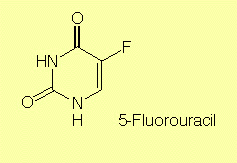 |
Fluorouracil is a substrate for thymidylate synthase, an enzyme which catalyses the conversion of deoxyuridine monophosphate (dUMP) to thymidine monophosphate (TMP) and thus plays a key role in the biosynthesis of pyrimidine bases. Thymidylate synthase converts Fluorouracil into 5-fluorodeoxyuridylate in vivo. Fluorouracil is a so-called suicide inhibitor of thymidylate synthase
... ... ... ...
... CONTINUE READING at cells-talk.com,
COPE's new home with 61 100+ entries, 141 552 cited references and >2,5
million internal hyperlinks. This most comprehensive knowledge base provides
extensive in-context information covering nomenclature, terminology, and
highlighting concepts, strategies & complexities of cellular communication
processes. COPE's fully integrated subdictionaries include
Dictionary of Angiogenesis •
Dictionary of Antimicrobial & host defense peptides •
Dictionary of Apoptosis and cell death •
Dictionary of CD antigens •
Dictionary of Chemokines •
Dictionary of Cryptides •
Dictionary of Cytokines & Growth factors •
Dictionary of Eukaryotic cell types & expression profiles •
Dictionary of Hematopoiesis •
Dictionary of Hormones •
Dictionary of Inflamation & inflammatory mediators •
Dictionary of Innate Immunity •
Dictionary of Metalloproteinases •
Dictionary of Moonlighting proteins & cryptides •
Dictionary of Neuropeptides •
Dictionary of Pathogenicity & Virulence Factors •
Dictionary of Pattern recognition receptors •
Dictionary of Protein domains •
Dictionary of Regulatory peptide factors •
Dictionary of Viroceptors •
Dictionary of Virokines •
Dictionary of Stem cells
and more.
An important note about your privacy: A search engine may have brought
you here. If the provided URL differs in any way from
"www.copewithcytokines.org/cope.cgi?key=search term", 3rd parties may
record your activities on COPE. Bypass snoopers by doing this: Go
directly to cells-talk.com or go to
copewithcytokines.org
in a new browser tab and from there explore whether COPE contains the terms
that interest you. The private bioinformatics initiative COPE at
cells-talk.com
never shares your search histories or user databank entry with 3rd parties.
| SUPPORT COPE | Intro | Subdictionaries | New Entries | Contribute data | COPE Credentials |
| # | A | B | C | D | E | F | G | H | I | J | K | L | M | N | O | P | Q | R | S | T | U | V | W | X | Y | Z |
|
Created, developed, and maintained by Dr H Ibelgaufts
|
U L T R A P O S S E N E M O O B L I G A T U R