
Horst Ibelgaufts' COPE:
Cytokines & Cells Online Pathfinder Encyclopaedia

COPE needs your support to remain a free service!


Advertising options

http://www.solulink.com/antibody_labeling.php COGITO ERGO COPE ADVERTISING SPACE Cell Sciences Inc
Cell Sciences Inc http://www.ebioscience.com/ Antimicrobial peptides

COPE Homepage Previous entry:
Antiproliferative protein
Next entry:
Antisense peptides
Random entry:
kte
Search COPE:

Antisense

Antisense RNA (also: ASO, antisense oligonucleotides) is complementary to the mRNA transcribed from a gene (see also: gene expression). These anti-mRNAs, or shorter oligonucleotides derived from the sequence of the mRNA under study, can form complexes with the primary RNA transcript of a gene.
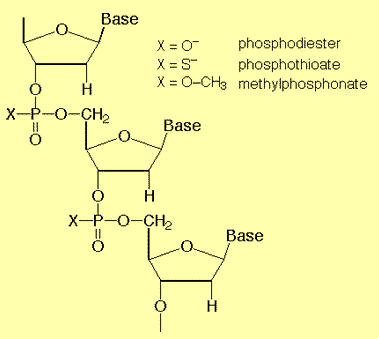

formula of antisenseoligo


The interaction of the antisense gene with its target is seen only when the target gene is expressed. The efficiency with which antisense RNA can be used to inhibit endogenous gene expression primarily not only depends on the synchronous or overlapping expression of the antisense RNA and the endogenous gene but usually also on a relative excess of the antisense transcripts.


formula of antisense


Complexes between sense RNA and antisense RNA effectively and specifically block the normal process of gene expression without affecting the expression of other genes because correct processing of the target gene transcript, its transport, or its translation by ribosomes either become impossible or are severely impaired. In some biological systems antisense RNAs has been found to be the natural method of gene control. Coker et al (1998) have described the occurrence of a natural TGF-beta-2 antisense transcript, which raises the possibility that such a transcript may play a role in regulating TGF-beta-2 production.

The introduction of antisense transcripts into living cells can be used effectively to block the activity of a gene, thus making it possible to analyze its function and the physiological consequences associated with the selective elimination of a particular protein. The use of antisense RNA is used often as an alternative to Knock-out mice that carry null mutations of the gene under study and are more difficult to produce (for a related approach see also: genetic ablation).

Antisense RNA can be used also to interfere with expression of growth factors, expression of growth factor receptor genes and/or expression of an oncogene (and of course, any desirable gene) at the level of transcription. Antisense induced reduction in the expression of oncogenes, including myb, myc, ras and fos, has been shown to inhibit growth and transformed phenotypes in various cell lines.

Antisense RNA has been used also to block the proliferation of tumor cells by functionally inactivating cytokines that function in an autocrine manner on these cells. The directed introduction of antisense RNA into tumor cells may be of potential clinical interest also, therefore, if the growth requirements of a tumor are known.

Peptides encoded in the antisense strand of DNA (Antisense peptides) have been found to bind to sense peptides and proteins with significant selectivity and affinity. Understanding the mechanism of sense-antisense peptide recognition may be helpful also to learn how to design agents that can be useful for separation, diagnostic and therapeutical purposes.

For other intracellular targeting strategies employed to inactivate intracellular target molecules see also: intrakine, intrabodies. For intracellular mechanisms of growth control see also: intracrine.


LAST MODIFIED: December 2001

See REFERENCES for entry Antisense


Antisense

The following COPE entries contain this entry term or one of its hypertext synonyms:

abl, ADAM10, ADAM8, Adenovirus E3 14.7 kDa protein, ADNP, Adrenomedullin, AFP, Agrin, A-LAP, ALG3, Angiogenin, Antisense peptides, Apollon, Apoptosin, APR1, APR2, APR3, AR, AS, ASC, ASH, ASO, Autocrine, BAR, BAX, BAX inhibitor-1, BCLg, Beta-IG-H3, bFGF, BFU-E, BHK, BIM, BRI3, Caenorhabditis elegans, Calsenilin, CARP-1, CAS, Caspy, CFU-GEMM, CFU-GM, CHO, CIIA, Clusterin, CNF1, Contactin-2, Cripto, CTGF, Cystatin-7, Cytokine gene transfer, Cytokine network, CytokineTopics, DAP-1, DAP-3, DAP-5, Daxx, delta-like, Deterin, ECF-L, EKS3, Ex-FABP, fes, Fibronectin, FLASH, Fortilin, frizzled-5, gas-3, GDF1, GDNF, GF-D8, GITR, glypican-1, Granins, GRIM, Growth hormone, GS-9L, HAX-1, HCD57, hck, HnudC, Homeotic genes, HPP-Q, hsp47, HuHGF, IB1, ID1, ID2, IEX-1L, IGF, IIS, IK factor, IL6, IL8, ING1, int-2, intrabodies, Intracrine, intrakine, IRAK2, IRS, ITA, Jagged, Knock-out, L87/4, Leprecan, LGL1, Livin, M1, Mcl-1, MDGI, Merkel cells, MIA, MIF, MK, MMP-11, MMP-1, MMP-7, MOPC-315, MTF, myb, Myeloblastin, NAC, NDRG4, NELL-2, Neuritin, NF-kappa-B, NGF, Nucleobindin-2, nur-77, OCIL, Oncomodulin, Osteopontin, OTOR, PAP-1, PAP-2, PAP-3, PBEF, PCDGF, PDCD4, PEA-15, PIDD, PL74, Plk-1, Prostate apoptosis response genes, PUMA, RA-A47, raf, RBM5, REG2, ribosomal protein S3a, S100, SAG, SCC-S2, Signal sequence, SMAC, Some personal remarks, sprouty, STK-1, T24, TACA, TF, TGIF factor, Thrombin, Thrombospondin-1, Thymic hormones, TIF2, TIMP-1, TPO, transgenic, TSAP6, TXBP151, Urocortin, Uteroglobin, UTMC-2, Vasohibin, VASP, vav, Villin, Wnt-1, XAF1, XIAP, Zac-1.

SUPPORT COPE | Intro | Subdictionaries | New Entries | Contribute data | COPE Credentials
# A B C D E F G H I J K L M N O P Q R S T U V W X Y Z

              Space for your TEXTLINK ADVERTISEMENTS. Please Inquire              


 HARVESTER  HGNC  iHOP  KEGG  MGI  OMIM  PUBMED

Cell Sciences Inc supports the COPE bioinformatics project with an unrestricted educational grant
Inquiries from other sides welcome

              Created, developed, and maintained by Prof Dr H Ibelgaufts              
About the author of COPE
  |    Contact COPE   |    postcard and stampware


Access to COPE is free only for academic institutions and non-profit organizations.
OTHER USERS: must contact COPE and pay a site licence fee.

Non-payment of the site licence fee is a serious breach of COPE's binding Usage Agreement.
If you do not wish to be bound by this agreement, do not use COPE
COPE is not in the public domain! The commercial use of COPE contents is not allowed.
Download of complete offline-readable copies and the use of automatic extraction methods are prohibited!

Usage Agreement, Disclaimer, Copyright Notice   |  All rights reserved by H Ibelgaufts   |  Privacy Statement

U L T R A   P O S S E   N E M O   O B L I G A T U R


cope.cgi version 24.7.04, revision Jan 15, 2010. (c) JI. Powered by Perl 5.008008 [b=5]