
![]() |
Horst Ibelgaufts' COPE:
Cytokines & Cells Online Pathfinder Encyclopaedia |
![]() |
|
|
|
|
|
|
| COPE Homepage | Bottom of page | Previous entry: phorbol 12-myristate 13-acetate |
Next entry: Phormicins |
Random entry: TRAP-1-like protein |
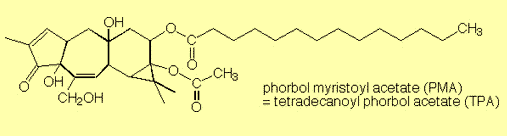
Phorbol esters are tumor-promoting compounds originally detected in oil prepared from seeds of Croton tiglium. Some esters, such as phorbol 12-myristate 13-acetate (abbr. PMA) or 12-O-tetradecanoyl-phorbol-13-acetate (abbr. TPA) have highly pleiotropic effects on cells in culture and on tissues in vivo and are used frequently in immunology as activators of T-cells and polyclonal B-cell activators in vitro.
![]() |
PMA acts as a direct agonist of protein kinase C, which plays a pivotal role in the cascade of events leading to B-cell activation (see also: cell activation; BCGF, B-cell growth factors). Treatment of a variety of cells with phorbol esters either induces or inhibits differentiation.
Phorbol esters activate the expression of a variety of early response gene through protein kinase C-dependent pathways. Many of these genes have been identified as TPA-inducible genes in PC12 cells (see: TIS genes). The rapid and co-ordinated expression of cytokines following treatment of cells with phorbol esters and other agents is due, at least in part, to the presence of regulatory sequence elements (see, for example: TRE, CLE) in the corresponding gene promoters (see also: gene expression, Response elements). Genes the expression of which is repressed by treatment with phorbol esters such as 12-O-tetradecanoyl-phorbol-13-acetate are also known (see, for example: TPA repressed gene-1).
Treatment of cells with phorbol esters frequently mimicks the effects of various cytokines and induces their synthesis and the synthesis of other gene products. Cultured cells stimulated with phorbol esters have been employed frequently in the search for new secreted cytokines. Active phorbol esters (for example, phorbol 12-myristate 13-acetate) can entirely replace IL3 to promote proliferation of FDCP1 cells and have been shown also to be able to replace IL2 in IL2 dependent human cell lines (see also: Factor-dependent cell lines).
For other agents used to dissect signal transduction pathways mediated by cytokines see: Bryostatins, Calcium ionophore, Calphostin C, Genistein, H8, Herbimycin A, K252a, Lavendustin A, Okadaic acid, Staurosporine, Suramin, Tyrphostins, Vanadate.
See REFERENCES for entry Phorbol esters
| COPE Homepage | Top of Page |
| SUPPORT COPE | Intro | Subdictionaries | New Entries | Contribute data | COPE Credentials |
| # | A | B | C | D | E | F | G | H | I | J | K | L | M | N | O | P | Q | R | S | T | U | V | W | X | Y | Z |
|
|
|
|
|
|
|
|
|
Created, developed, and maintained by Prof Dr H Ibelgaufts
|
| Access to COPE is free only for academic institutions and non-profit organizations. OTHER USERS: must contact COPE and pay a site licence fee. Non-payment of the site licence fee is a serious breach of COPE's binding Usage Agreement. If you do not wish to be bound by this agreement, do not use COPE |
| COPE is not in the public domain! The commercial use of COPE contents is not allowed. Download of complete offline-readable copies and the use of automatic extraction methods are prohibited! Usage Agreement, Disclaimer, Copyright Notice | All rights reserved by H Ibelgaufts | Privacy Statement U L T R A P O S S E N E M O O B L I G A T U R |